The prairie ecosystem historically covered over 150 million acres ranging from the western Rocky Mountains to the eastern forests near the Mississippi River. The prairie ecosystem spread from the north in Saskatchewan to south in Texas. The Prairie ecosystem was the dominant ecosystem in North America up until the mid-1800s. The prairie ecosystem is one of the most diverse with about 50-60 types of grasses and about 300-400 forbs. Prairies covered many different types of landscapes, with different soils, and many extreme weather conditions. Prairies could face periods of drought, flooding, extreme heat, and extreme cold. Prairies often times were faced with fire and some species rely on fire in order to complete their reproduction cycles. Another challenge to prairies was the intense grazing of elk, deer, bison, and pronghorn antelope. These native prairie plants have evolved over time to survive the extremes by producing most of their biomass, around 75%to 80%, below the soil where the temperatures are fairly constant and the above ground threats are not dangerous. However, today the prairie ecosystem covers at most 2% of its original landmass. As the prairie diminishes, so does its flora and fauna. Without the prairie, many species of birds, small mammals, and insects have begun to decline as well. You can help preserve this ecosystem by planting a back yard prairie. A backyard prairie can be very easy to plant and can offer countless hours of enjoyment. A native prairie will provide microhabitats and rest stops for native species that are either living in them or that are just passing through. Big bluestem, one of the most common native grasses, provides food and cover for many birds and animals. By planting big bluestem you can also get enjoyment out of its fall color and structure. Another great backyard prairie plant is a cardinal flower. Cardinal flower is a favorite of hummingbirds and provides food for many pollinators. It is a very attractive bright red flower that also has a strong sweet scent. Another great choice for a backyard prairie is the purple coneflower. The purple coneflower is a great source of food for pollinators and also very aesthetically pleasing to the home gardener. Making a backyard prairie can be quite a deal of fun and allow for people to reconnect with nature and help to educate others. In the rapidly expanding and globalizing world, nature is facing more dangers and destruction and every little bit can help. A backyard prairie may not save the bison, but it sure will help the insects, snakes, and birds.
Sources: “Tallgrass Prairie Center.” Tallgrass Prairie Center, 1 May 1970, tallgrassprairiecenter.org/.
“A Complex Prairie Ecosystem.” National Parks Service, U.S. Department of the Interior, http://www.nps.gov/tapr/learn/nature/a-complex-prairie-ecosystem.htm.
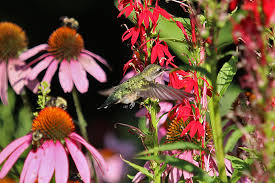
A ruby-throated hummingbird feeding on cardinal flower and purple coneflower.
Picture provided by: Back Yard Biology, bybio.wordpress.com/tag/archilochus-colubris/.

 Conservation Biology